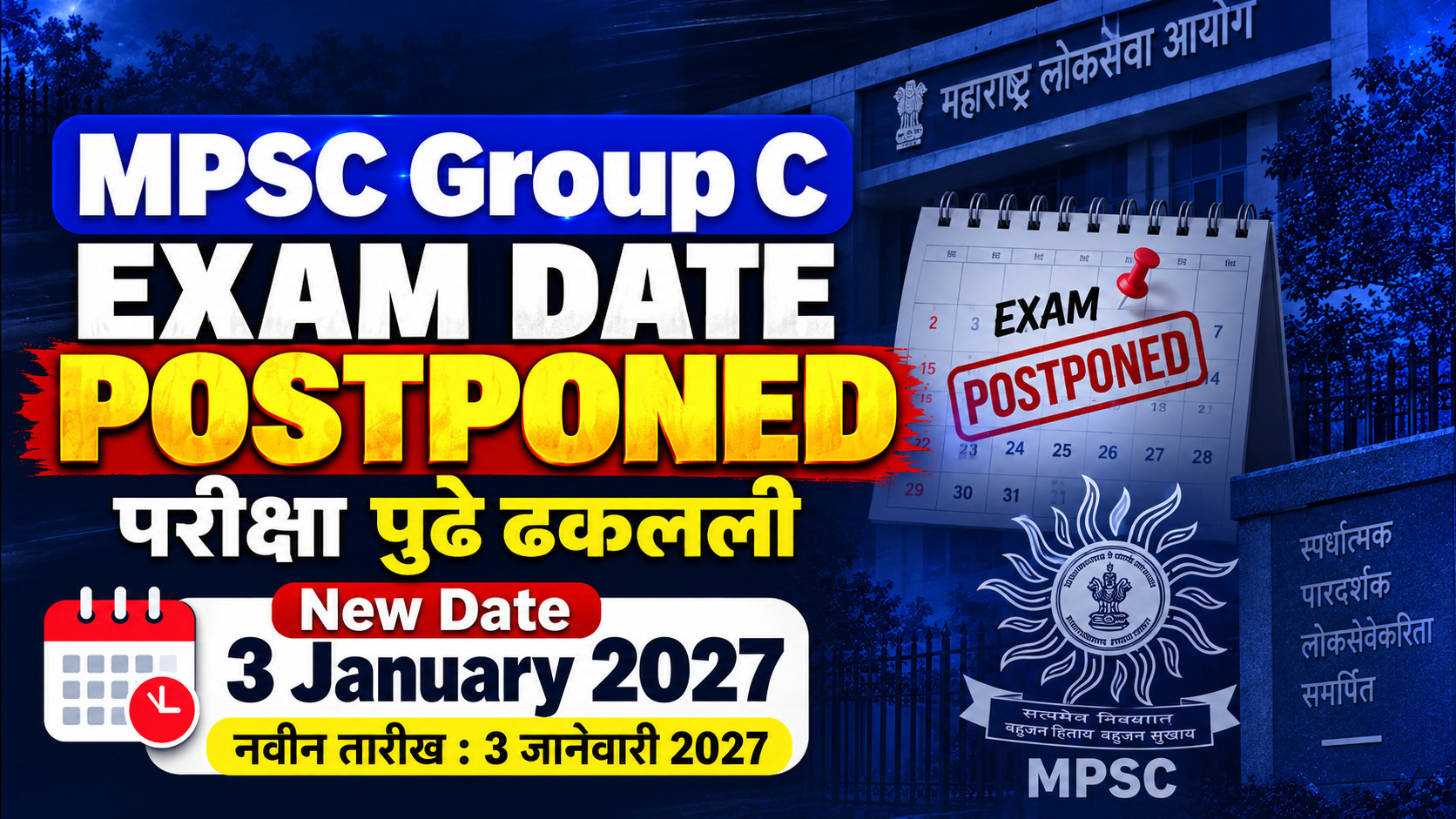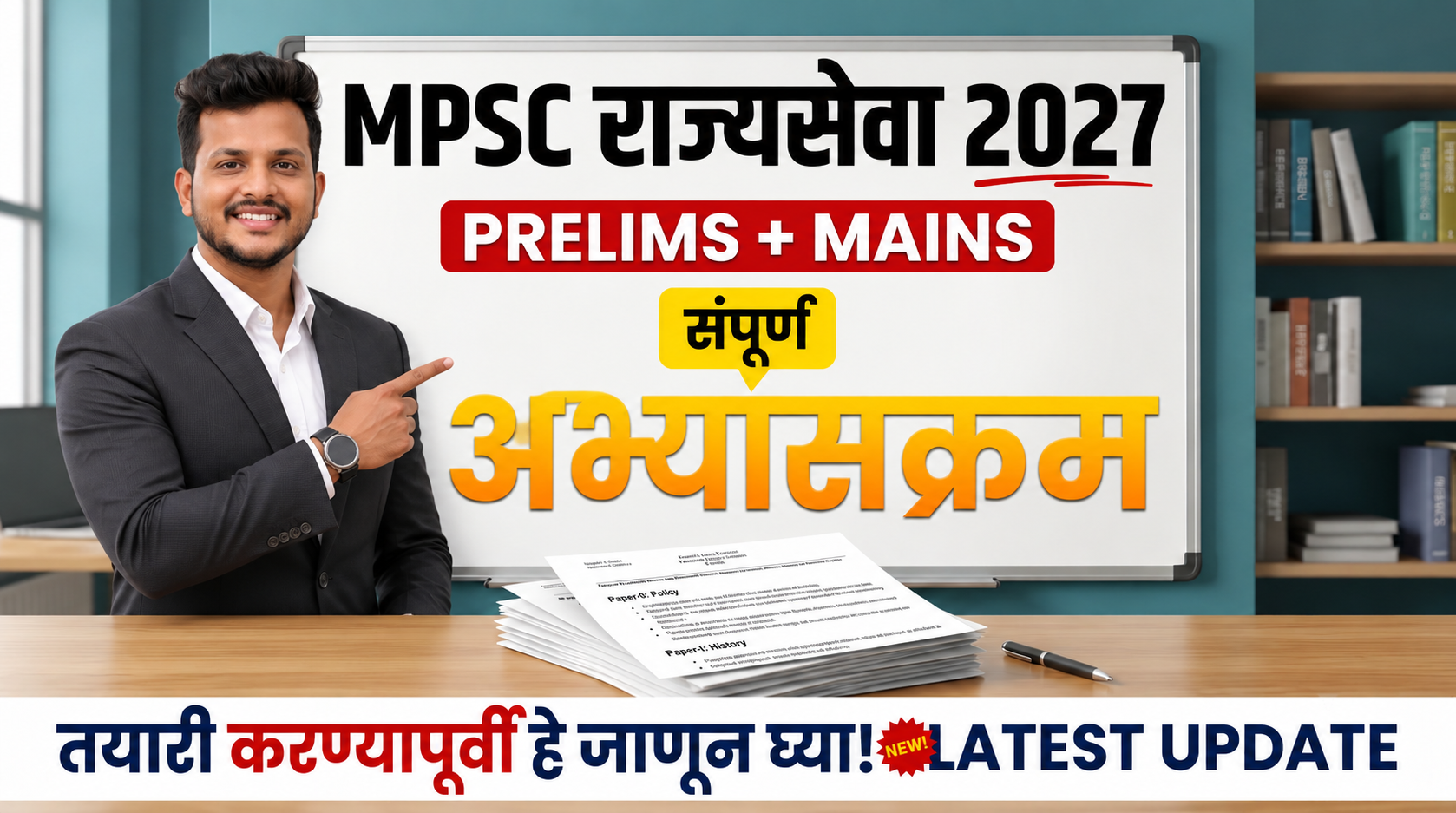
The Maharashtra Public Service Commission (MPSC) has rolled out one of the biggest reforms in the history of the State Services (Rajyaseva) Examination. Through an official notification dated 25 June 2026, MPSC has overhauled the Mains exam structure and confirmed a shift to online testing for Prelims — changes that will apply from the MPSC Rajyaseva 2027 cycle onward.
If you're preparing for this exam, this changes almost everything about how you should plan your studies. Here's a complete, up-to-date breakdown of the MPSC Rajyaseva 2027 syllabus and exam pattern.
Quick Answer: From the 2027 cycle, MPSC Rajyaseva has removed the optional subject entirely. Mains now has 7 compulsory papers (2 qualifying language papers + Essay + GS I–IV) worth 1250 marks, Prelims is shifting to online CBT mode, and the Interview stays at 275 marks — making the total merit out of 1525 marks.
|
Particular |
Details |
|
Exam Name |
MPSC State Services (Rajyaseva) Examination |
|
Conducting Body |
Maharashtra Public Service Commission (MPSC) |
|
Notification Date |
25 June 2026 |
|
Applicable From |
MPSC Rajyaseva 2027 cycle |
|
Biggest Change |
Optional subject completely removed |
|
Mains Papers |
7 compulsory papers (down from 9) |
|
Prelims Mode |
Shifting to Online Computer-Based Test (CBT) |
|
Total Written Marks |
Reduced from 1750 to 1250 |
|
Interview Marks |
275 (unchanged) |
|
Final Merit Marks |
1525 (down from 2025) |
For years, aspirants and coaching experts pointed out that choosing an optional subject created an uneven playing field — some subjects were simply easier to score in than others, which skewed the final merit list. MPSC's stated goal with this reform is to:
It's worth noting that this revised pattern applies only to the State Services (Rajyaseva) exam — MPSC's Engineering Services, Forest Services, Agriculture Services, and other specialized/department exams are not affected and continue under their existing patterns.
The selection process still has three stages, but two of them look quite different now:
The Prelims continues to be an objective-type screening exam, but the biggest change here is the shift to Computer-Based Test (CBT) / online mode, replacing the traditional offline OMR-based test. This is expected to bring:
Prelims structure:
|
Paper |
Subject |
Nature |
|
Paper I |
General Studies |
Merit-based, counted for qualifying |
|
Paper II |
CSAT (Aptitude) |
Qualifying |
Candidates who clear the Prelims cut-off become eligible to appear for the Main Examination.
This is where the real transformation has happened. Previously, Rajyaseva Mains had 9 papers: two qualifying language papers, one essay, four compulsory General Studies papers, and two optional subject papers (worth 500 marks) chosen by the candidate.
From 2027, the optional subject has been scrapped entirely. Every candidate now writes the same seven compulsory papers.
|
Paper |
Subject |
Nature |
|
Paper I |
Marathi Language |
Qualifying |
|
Paper II |
English Language |
Qualifying |
|
Paper III |
Essay |
Counted for merit |
|
Paper IV |
General Studies I |
Counted for merit |
|
Paper V |
General Studies II |
Counted for merit |
|
Paper VI |
General Studies III |
Counted for merit |
|
Paper VII |
General Studies IV |
Counted for merit |
Key points to note:
|
Feature |
Old Pattern |
New Pattern (2027) |
|
Optional Subject |
Yes (1 subject, 2 papers) |
Removed |
|
Total Mains Papers |
9 |
7 |
|
Compulsory (non-language) Papers |
5 |
5 |
|
Total Written Marks |
1750 |
1250 |
|
Basis of Merit |
GS + Optional |
Essay + GS only |
|
Evaluation Style |
Subject-based (varied scoring) |
Uniform, standardized |
Both language papers test comprehension and expression rather than literary depth. Expect:
Candidates are typically asked to write essays on multiple topics — often touching on social, economic, political, and developmental themes. The focus is on structured thinking: a clear introduction, a well-organized body, and a balanced conclusion, all while staying tightly on-topic.
Theme: Indian Heritage & Culture, History, and Geography (India & World), with Maharashtra-specific weightage
Theme: Constitution, Polity, Governance, Social Justice & International Relations, with Maharashtra-specific weightage
Theme: Economy, Agriculture, Science & Technology, Environment, and Security, with Maharashtra-specific weightage
Theme: Ethics, Integrity, and Aptitude (with Human Rights & HRD elements)
The Interview stage remains unchanged at 275 marks. It's designed to assess:
Nationality: Must be an Indian citizen.
Educational Qualification: A bachelor's degree from a recognized university. Final-year students can apply for Prelims but must complete their degree before applying for Mains. Some specialized posts may need specific qualifications.
Marathi Language Proficiency: Candidates should be able to read, write, and speak Marathi — the Marathi paper remains compulsory and qualifying.
Age Limit:
|
Category |
Minimum Age |
Maximum Age |
|
General |
19 years |
38 years |
|
OBC |
19 years |
43 years |
|
SC/ST |
19 years |
43 years |
|
PwD |
19 years |
45 years |
|
Ex-Servicemen |
As per rules |
As per rules |
Age relaxations may apply as per MPSC's official rules — always cross-check with the latest official notification.
Clearing this exam can lead to prestigious Group A and Group B gazetted posts in Maharashtra, including:
With optional subjects gone, your entire preparation strategy needs to pivot toward depth in General Studies rather than breadth across an extra specialized subject. Here's where to focus:
Q1. From which year does the new MPSC Rajyaseva exam pattern apply? The new pattern applies from the MPSC Rajyaseva 2027 examination cycle onward, as per MPSC's notification dated 25 June 2026.
Q2. Has MPSC removed the optional subject from Rajyaseva Mains? Yes. MPSC has completely removed the optional subject (2 papers, 500 marks) from the Rajyaseva Mains exam starting 2027.
Q3. How many papers does the MPSC Mains 2027 exam have? The MPSC Mains 2027 exam has 7 papers: Marathi (qualifying), English (qualifying), Essay, and General Studies I, II, III, and IV.
Q4. Is the MPSC Rajyaseva Prelims exam online or offline in 2027? The MPSC Rajyaseva Prelims exam is shifting to online Computer-Based Test (CBT) mode from the 2027 cycle, replacing the earlier offline OMR format.
Q5. Has the MPSC interview marks changed for 2027? No. The MPSC Personality Test (Interview) remains unchanged at 275 marks.
Q6. What is the total marks for MPSC Rajyaseva 2027 final merit? The final merit is calculated out of 1525 marks — 1250 marks from the written Mains exam plus 275 marks from the interview.
Q7. Does the new MPSC pattern apply to other exams like Engineering or Forest Services? No. The revised pattern applies only to the State Services (Rajyaseva) Examination. MPSC Engineering Services, Forest Services, Agriculture Services, and other specialized exams are unaffected.
Q8. What should MPSC Rajyaseva 2027 aspirants focus on now? Aspirants should focus on all four General Studies papers, Essay writing, and current affairs, since these now form the entire basis of the Mains merit list.
Q9. What was the MPSC Rajyaseva Mains total marks before the 2027 change? Before 2027, MPSC Rajyaseva Mains had 9 papers totaling 1750 marks, including two optional subject papers worth 500 marks.
Q10. Where can I download the official MPSC Rajyaseva 2027 syllabus PDF? The official syllabus and notification are available on MPSC's official website at mpsc.gov.in.
The MPSC Rajyaseva 2027 reform is a major shift — removing the optional subject changes not just how many papers you write, but how you should be studying starting today. If you're an aspirant, the smartest move now is to build a broad, strong command over all four General Studies papers and Essay writing, while treating Marathi and English as must-clear qualifiers.
Stay tuned to MPSC's official website (mpsc.gov.in) for the detailed official notification and any further clarifications, since exam bodies sometimes fine-tune details before the exam actually rolls out.
This article will be updated as MPSC releases further official notifications, detailed syllabus PDFs, and exam calendars for the Rajyaseva 2027 cycle.