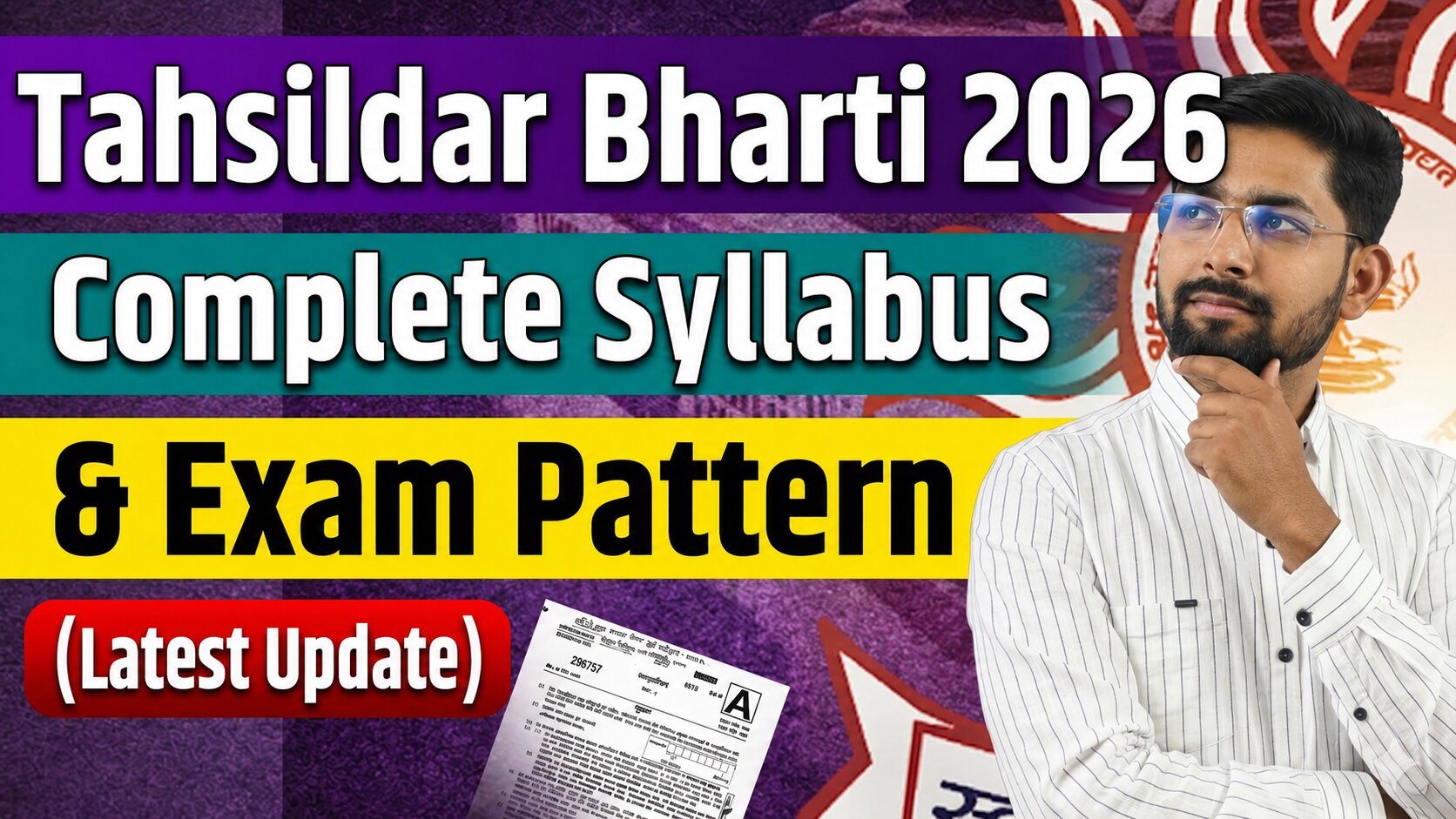
Tahsildar is a Group A gazetted post in the Maharashtra Revenue Department. It is recruited through the MPSC Rajyaseva (State Services) Exam. There is no separate Tahsildar Bharti notification published by MPSC or the Maharashtra government.
For aspirants who want a faster government job in the revenue department, there's a second route: the Naib Tahsildar post, which is a Group B gazetted post recruited through the MPSC Combined Group B Subordinate Services Exam. After 5 to 8 years of service, a Naib Tahsildar gets promoted to Tahsildar.
This guide covers both routes with the latest 2026 syllabus, exam pattern, dates, and the major change every aspirant needs to know about: the revised descriptive Mains pattern.
Route 1: Direct entry through MPSC Rajyaseva
The Maharashtra Civil Services Gazetted Combined Examination selects officers for senior posts including Deputy Collector, DySP, Tahsildar, BDO, and Assistant Commissioner of State Tax. The 2026 cycle has 79 vacancies. The 2025 cycle is still active with 150 vacancies in process.
Route 2: Promotion from Naib Tahsildar
Naib Tahsildar candidates are selected through the MPSC Combined Group B exam. After serving for several years and clearing departmental tests, they get promoted to Tahsildar.
For most aspirants in Nashik and across Maharashtra, Rajyaseva is the preferred direct route because it skips the promotion timeline.
The Prelims has 2 papers, both objective type, held on the same day.
Only Paper 1 marks decide who moves to Mains. Paper 2 must be qualified, but its marks do not count toward the cut-off.
The Paper 1 syllabus covers 7 broad areas. Expect heavy Maharashtra-specific weightage.
1. History of India and the Indian National Movement
Maharashtra topics with heavy weightage: Shivaji Maharaj's administration and Ashtapradhan, the Bhakti movement (Sant Tukaram, Sant Dnyaneshwar, Sant Eknath), Satyashodhak Samaj (Mahatma Phule, Savitribai Phule), Lokmanya Tilak, Dr. Babasaheb Ambedkar, Karmaveer Bhaurao Patil, and the Samyukta Maharashtra Movement.
2. Geography of India and Maharashtra
Physical, social, and economic geography. Sahyadri ranges, Konkan coast, Vidarbha drought patterns, Western Maharashtra's sugar belt, major river systems (Godavari, Krishna, Tapi, Bhima). Climate, soils, agriculture, mineral resources.
3. Indian Polity and Governance
Constitution, fundamental rights, DPSP, Panchayati Raj (73rd and 74th amendments), Maharashtra's administrative structure (district, taluka, gram panchayat). Public policy and welfare schemes.
4. Economic and Social Development
Sustainable development, poverty, inclusion, demographics. Maharashtra's industrial corridors (MMR, Pune, Aurangabad, Nashik), MSMEs, agricultural economy.
5. General Issues on Environmental Ecology and Biodiversity
Climate change, conservation, environmental protection. Maharashtra-specific: Tadoba, Sahyadri Tiger Reserve, Western Ghats biodiversity hotspots.
6. General Science
Physics, chemistry, biology basics. Application-based questions on everyday science.
7. Current Affairs
National and international events, with heavy focus on Maharashtra. Cover at least the past 12 months.
CSAT tests reasoning, aptitude, and comprehension. The qualifying threshold is 33%.
We have seen aspirants in Nashik score 140+ in Paper 1 and get disqualified because they ignored CSAT. Treat CSAT as a daily 30-minute practice habit from the start.
MPSC has shifted the Mains from objective-type to descriptive-type, similar to the UPSC Civil Services pattern. This is the biggest change in Maharashtra's exam structure in years and applies directly to every Tahsildar aspirant writing in 2026 and beyond.
6 papers, all compulsory:
|
Paper |
Subject |
Marks |
Duration |
Nature |
|
Paper A |
Marathi (compulsory) |
300 |
3 hours |
Descriptive, qualifying |
|
Paper B |
English (compulsory) |
300 |
3 hours |
Descriptive, qualifying |
|
Paper 1 |
Essay |
250 |
3 hours |
Descriptive |
|
Paper 2 |
General Studies 1 |
250 |
3 hours |
Descriptive |
|
Paper 3 |
General Studies 2 |
250 |
3 hours |
Descriptive |
|
Paper 4 |
General Studies 3 |
250 |
3 hours |
Descriptive |
Papers A and B (language) are qualifying. You need to pass them, but the marks are not added to the final merit.
Final merit is calculated from: Essay (250) + 3 GS papers (750) + Interview (275) = 1275 marks total.
History, geography, and society.
Constitution, polity, social justice, international relations.
Economy, science and technology, environment, security, disaster management.
Ethics, integrity, and aptitude. This is new in the revised pattern and carries direct relevance to the Tahsildar role.
The Tahsildar post involves heavy public dealing: revenue disputes, election duty, disaster relief coordination, land record corrections, encroachment removal. The Ethics paper has direct on-the-job application.
Two essays of around 1000 to 1200 words each.
Topics regularly pull from current affairs. Recent examples: agricultural distress in Vidarbha, Uniform Civil Code debate, AI and employment in India, climate action and Indian agriculture.
For aspirants targeting Tahsildar specifically, expect direct questions on:
Education
Bachelor's degree from a recognised university in any discipline. Final-year students can apply provisionally, but they must submit proof of passing before the Mains.
Age limit (as of 1 April 2026)
Domicile
Must be a domicile of Maharashtra.
Language requirement
Must have studied Marathi up to SSC level, or pass an MPSC-prescribed Marathi proficiency test.
Number of attempts
If you want a faster government job and are open to starting one rung below Tahsildar, the Naib Tahsildar post is your route.
MPSC Combined Group B exam pattern
Prelims (common for PSI, STI, ASO, Naib Tahsildar, Sub-Registrar, Tax Assistant): 100 questions, 100 marks, 1 hour duration. Objective type with negative marking.
Mains: Two papers, 100 marks each, 1 hour each. Paper 1 is common across all posts. Paper 2 is post-specific.
For Naib Tahsildar Mains Paper 2, the heaviest weightage falls on:
Interview: 100 marks.
Naib Tahsildar entry salary is ₹38,600 to ₹1,32,300 per month plus allowances. Promotion to Tahsildar typically happens in 5 to 8 years based on departmental exams and service record. Tahsildar pay scale is ₹55,100 to ₹1,75,100 per month.
Two important updates aspirants must know:
1. Descriptive Mains pattern is now active
MPSC has shifted from the older objective-type Mains to a descriptive-type Mains, effective from March 2026. The Rajyaseva Mains 2025 is being conducted in this new descriptive format (papers held on 5, 18, 19, 26 April and 2 May 2026). The 2026 cycle Mains will also follow the same format. This change raises the difficulty significantly and changes how preparation should be structured.
2. Parallel 2025 and 2026 cycles
The 2026 notification has 79 posts. The 2025 cycle is still in process with 150 Rajyaseva vacancies. Many aspirants are writing 2025 Mains in April-May 2026 while preparing for 2026 Prelims (held 31 May 2026). Plan your timeline accordingly.
Here's what we have seen work for serious aspirants at our academy:
Entry salary: ₹55,100 to ₹1,75,100 per month (7th Pay Commission, Pay Level 10)
Allowances:
Posting: Taluka headquarters across Maharashtra. As a Tahsildar, you head the taluka revenue administration, conduct elections, supervise land records, manage disaster relief, and execute government schemes at the taluka level.
Promotion path: Tahsildar, then Deputy Collector, then Additional Collector, then Collector (and further IAS-cadre roles if promoted to IAS).
Tahsildar is a senior post in Maharashtra's revenue hierarchy with full administrative authority over a taluka, a salary range of ₹55,100 to ₹1,75,100 per month, and a clear promotion path into senior civil service ranks.
The recruitment route is MPSC Rajyaseva for direct entry, or MPSC Combined Group B (Naib Tahsildar) for the longer route through promotion.
The syllabus is published. The pattern is now descriptive. The dates are set. The only variable left is your preparation.
MPSC Rajyaseva & Naib Tahsildar Coaching in Nashik
For MPSC Rajyaseva and Naib Tahsildar coaching in Nashik, visit Karmayogi Academy in Panchavati. Our faculty includes serving and former government officers who cleared the same exams they now teach.